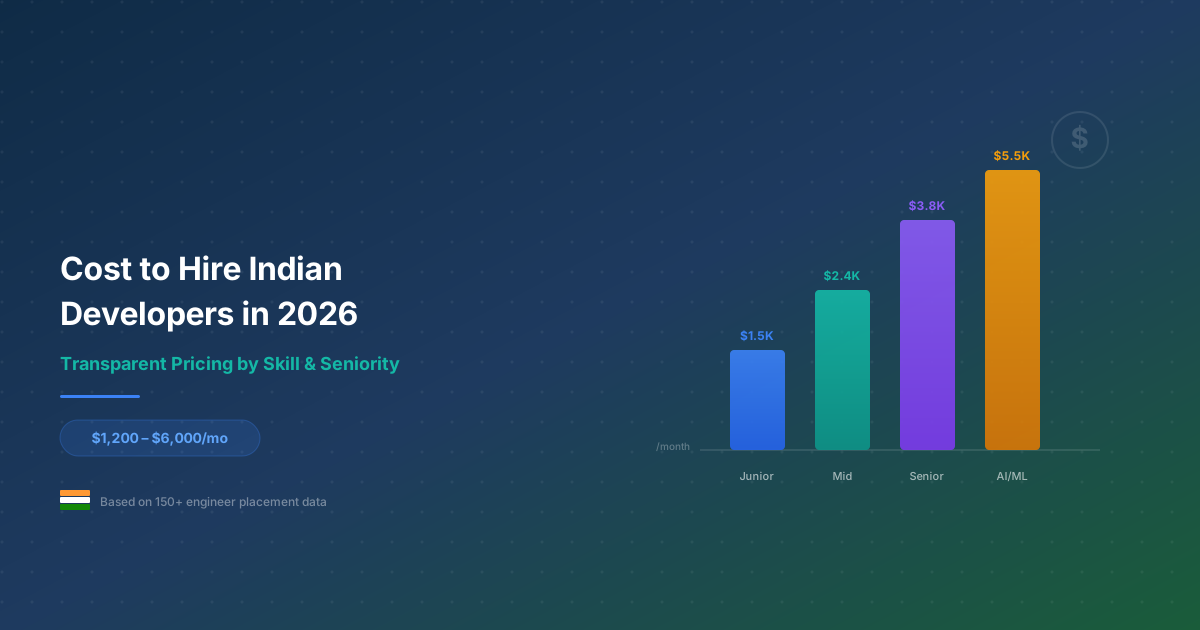
Dedicated Indian developer costs range from $1,200 to $6,000 per month full-time in 2026, depending on skill level and specialization. Junior (0–3 yrs): $1,200–$1,800. Mid-level (3–7 yrs): $1,800–$2,800. Senior (7+ yrs): $2,800–$4,500. AI/ML specialist: $3,500–$6,000. All figures are based on LegelpTech's 2025–2026 placement data across 150+ engineers and four delivery centers in India.
If you're a CTO or VP Engineering at a 20–200 person SaaS or fintech company, you've almost certainly run this calculation: hire locally at $120K–$180K fully loaded, or engage a dedicated Indian developer at a fraction of that cost without sacrificing output quality. The math isn't complicated — but the pricing transparency in this market is terrible. Most vendors hide behind "contact us for a quote" because their margins depend on information asymmetry.
This article kills that asymmetry. We're publishing LegelpTech's actual rate bands by role and seniority, the total cost of employment formula so you can compare apples to apples, and a region-by-region benchmark so you can evaluate India against the Philippines, Latin America, and Eastern Europe with real numbers.
2026 Dedicated Developer Rates by Role and Seniority
These rates reflect LegelpTech's actual bill rates for dedicated full-time developers placed with clients in the US, UK, and Australia during Q4 2025 through Q1 2026. Rates include developer salary, benefits, workspace, equipment, HR management, and a dedicated account manager. They do not include your internal management overhead or any software license costs specific to your stack.
| Role | Junior (0–3 yrs) | Mid-Level (3–7 yrs) | Senior (7+ yrs) | Lead/Architect (10+ yrs) |
|---|---|---|---|---|
| Full-Stack Developer | $1,400–$1,800 | $2,000–$2,800 | $3,000–$4,200 | $4,500–$5,500 |
| Frontend (React/Next.js) | $1,200–$1,600 | $1,800–$2,500 | $2,800–$3,800 | $4,000–$5,000 |
| Backend (Node/Python/Java) | $1,400–$1,800 | $2,000–$2,800 | $3,000–$4,200 | $4,500–$5,500 |
| Mobile (React Native/Flutter) | $1,400–$1,800 | $2,200–$2,800 | $3,200–$4,200 | $4,500–$5,500 |
| DevOps / Cloud Engineer | $1,600–$2,000 | $2,400–$3,000 | $3,200–$4,500 | $4,800–$6,000 |
| AI/ML Engineer | $1,800–$2,200 | $2,800–$3,800 | $3,800–$5,500 | $5,500–$6,000+ |
| Data Engineer / Analyst | $1,400–$1,800 | $2,000–$2,800 | $3,000–$4,000 | $4,200–$5,200 |
| WordPress / PHP Developer | $1,000–$1,400 | $1,500–$2,200 | $2,400–$3,200 | $3,500–$4,200 |
| QA / Test Automation | $1,200–$1,600 | $1,800–$2,400 | $2,600–$3,500 | $3,800–$4,500 |
A few patterns worth noting. AI/ML and DevOps command the highest premiums — senior AI engineers can cost 3x what a junior WordPress developer costs. This reflects genuine market scarcity: India produces roughly 1.5 million CS graduates annually, but fewer than 5% have production-grade ML experience. At LegelpTech, our AI/ML team of 18 engineers has an average tenure of 3.4 years because retention in this segment requires above-market compensation and meaningful project work.
What's Actually Included in These Rates
One of the biggest mistakes buyers make is comparing a freelancer's hourly rate to a dedicated team provider's monthly rate without understanding what's bundled. A $15/hour freelancer on a generalist freelance platform is not comparable to a $2,400/month dedicated developer from a managed team. Here's what LegelpTech's rates include versus what you'd need to separately arrange with a freelancer.
| Cost Component | Included in LegelpTech Rate | Freelancer (You Manage) |
|---|---|---|
| Base Salary | Yes | You pay directly |
| Health Insurance & Benefits | Yes (PF, ESI, medical) | Not included |
| Equipment (Laptop, Monitors) | Yes | You provide or reimburse |
| Office Space / Internet | Yes (4 delivery centers) | Their home setup |
| HR & Payroll Management | Yes | You handle or hire EOR |
| Dedicated Account Manager | Yes | Not available |
| Backup Developer Policy | Yes (replacement within 2 weeks) | You re-hire from scratch |
| Performance Reviews | Yes (quarterly) | You conduct |
| IP & NDA Protection | Yes (employment-grade) | Contractor agreement only |
| Time Zone Overlap (4+ hrs) | Yes (managed overlap) | Depends on freelancer |
Total Cost of Employment Formula
When comparing hiring options, use the Total Cost of Employment (TCE) formula to normalize across models. This is the formula we use internally at LegelpTech when advising clients on build-vs-buy decisions.
TCE = Bill Rate + Internal Management Overhead (8–15% of bill rate) + Software Licenses ($50–$300/month) + Communication Tools ($20–$50/month) + Ramp-Up Cost (1–2 months at 50% productivity for new hires)
For a mid-level full-stack developer at $2,400/month from LegelpTech, the TCE works out to approximately $2,700–$2,900/month once you factor in your project management time and tooling. Compare that to hiring the same developer locally in the US: $95,000–$130,000 base salary plus 25–35% benefits loading equals $10,000–$14,500/month fully loaded — roughly 4–5x the cost for equivalent output.
Across our 150-engineer base, we've tracked productivity data for three years. Our dedicated developers working 4+ hour timezone overlaps with US clients consistently deliver 85–92% of the output velocity of co-located engineers, measured by sprint velocity and deployment frequency. The productivity discount is real but modest — and the cost arbitrage more than compensates.
India vs. Philippines vs. LATAM vs. Eastern Europe: 2026 Cost Comparison
India isn't the only offshore destination. Here's how 2026 rates compare across the four most common regions for dedicated developer hiring, based on market data and LegelpTech's competitive benchmarking.
| Factor | India | Philippines | Latin America (LATAM) | Eastern Europe (Poland/Ukraine) |
|---|---|---|---|---|
| Mid-Level Full-Stack Rate | $2,000–$2,800/mo | $2,200–$3,000/mo | $3,500–$5,000/mo | $4,000–$6,000/mo |
| Senior Full-Stack Rate | $3,000–$4,200/mo | $3,200–$4,500/mo | $5,000–$7,500/mo | $5,500–$8,000/mo |
| AI/ML Engineer Rate | $2,800–$5,500/mo | $3,500–$5,000/mo | $5,000–$8,000/mo | $5,500–$9,000/mo |
| Talent Pool Size (Developers) | 5.8 million | 190,000 | 1.2 million | 1.4 million |
| English Proficiency | High (business fluent) | High (native-level) | Moderate (varies) | Moderate to High |
| US Timezone Overlap | 3–5 hrs (IST shift) | 0–2 hrs (minimal) | 6–8 hrs (natural) | 5–7 hrs (partial) |
| AI/ML Talent Depth | Very Deep | Limited | Growing | Strong |
| Cost Savings vs. US | 70–80% | 60–70% | 40–55% | 35–50% |
| Scalability (50+ devs) | Easy | Challenging | Moderate | Moderate |
| Best For | Scale, AI/ML, cost | Support, content | Timezone, design | Niche specialization |
India's advantage is the intersection of cost, talent depth, and scalability. When a client asks LegelpTech to scale from 5 to 25 developers in 60 days, we can do it — drawing from four delivery centers across Noida, Gurgaon, Bangalore, and Hyderabad. Try that in the Philippines or LATAM and you'll hit ceiling constraints within weeks. For teams under 5 developers, LATAM's timezone advantage is compelling. For teams over 10, India's economics and talent depth become decisive.
How AI Augmentation Is Changing Developer Pricing in 2026
The single biggest shift in 2026 developer economics isn't wage inflation or currency fluctuation — it's AI-augmented productivity. This is directly affecting what clients should pay and what they should expect in return.
"We've measured a 30–40% increase in code output per developer since rolling out AI pair-programming tools across our 150-engineer team in mid-2025. A mid-level developer today ships what a senior developer shipped 18 months ago. That doesn't mean mid-level rates should equal senior rates — it means the value per dollar of a mid-level hire has increased substantially." — Chandra Prakash, Founder & CTO, LegelpTech
What this means practically for hiring decisions: a team of 4 AI-augmented mid-level developers from India at $2,400/month each ($9,600/month total) now produces roughly the same output as 3 senior developers at $4,000/month each ($12,000/month). The cost difference is $2,400/month — $28,800 annually — while maintaining equivalent velocity.
At LegelpTech, every developer ships with GitHub Copilot, internal code review tooling, and access to AI-assisted testing frameworks. This isn't an upsell — it's included in the standard rate because it makes business sense for both sides. Higher output per developer means better client outcomes and better project economics.
"The companies still hiring purely on hourly rate are optimizing the wrong variable. The question isn't 'what does a developer cost per hour' — it's 'what does a deployed feature cost.' When you measure cost-per-feature, AI-augmented teams from India are running at roughly 15–20% of US-equivalent cost. That's the number that should drive your hiring math." — Chandra Prakash, Founder & CTO, LegelpTech
Engagement Models and How They Affect Pricing
The rates above assume a dedicated full-time model — one developer working exclusively for your company, 8 hours per day, 5 days per week. But there are variations, and each affects the monthly rate differently.
| Model | Typical Discount/Premium | Best For | Risk Level |
|---|---|---|---|
| Dedicated Full-Time | Base rate (as quoted above) | Ongoing product development | Low — full integration |
| Part-Time Dedicated (4 hrs/day) | 55–65% of full-time rate | Early-stage startups, MVPs | Medium — split attention |
| Project-Based (Fixed Scope) | 10–20% premium on equivalent hours | One-time builds, migrations | Higher — scope creep risk |
| Team Augmentation (3+ devs) | 5–10% volume discount | Scale-ups needing speed | Low — managed team dynamics |
| Managed Team (PM included) | 15–25% premium | Non-technical founders | Lowest — turnkey delivery |
For staff augmentation versus EOR (Employer of Record) models, the distinction matters for compliance and long-term cost. Staff augmentation through a provider like LegelpTech means the developer is our employee — we handle all Indian labor law compliance, taxes, and benefits. EOR is a lighter arrangement where you're technically the employer but outsource payroll to a third-party. For a detailed comparison of these models, RemoteStaffingWiki.com has a comprehensive breakdown of EOR vs. staff augmentation structures.
What Drives Price Variation Within the Same Role
You'll notice the rate bands have $600–$1,200 of spread within each cell. That variation isn't arbitrary — it maps to specific factors.
- Domain experience matters more than raw years: A 4-year developer with fintech and PCI-DSS experience commands mid-to-senior rates because the ramp-up time for your project drops from 6 weeks to 1 week. At LegelpTech, we've built payment systems for 8 fintech clients — those developers price at the top of their seniority band.
- Stack specificity creates premiums: React/Node is commodity. Rust, Elixir, or specialized cloud-native architectures (Kubernetes operators, service mesh) command 15–25% premiums because the supply is genuinely thinner.
- Timezone flexibility is priced in: A developer willing to work 100% US business hours (IST night shift) costs 10–15% more than one working a 4-hour overlap model. LegelpTech's default is 4+ hours of overlap, which works for 90% of async engineering teams.
- Commitment length affects pricing: A 12-month engagement locks in rates and often comes with a 5–8% discount versus month-to-month. This reflects reduced recruitment and onboarding costs on our side.
- Certifications add value selectively: AWS Solutions Architect, Google Cloud Professional, or Kubernetes CKA certifications justify $200–$400/month premium — but only if your project actually uses those platforms.
Red Flags in Developer Pricing: What to Watch For
After placing 150+ engineers with global clients, we've identified the pricing signals that predict trouble.
- Rates significantly below market ($800–$1,000 for a 'senior' developer): This usually means a junior developer will be presented as mid-level, or the vendor is sub-contracting to an even cheaper provider and has no control over quality or retention.
- No clear breakdown of what's included: If the vendor can't tell you exactly what's bundled in the rate — benefits, equipment, management, IP protection — you'll discover hidden costs in month 3.
- Refusal to share developer profiles before commitment: At LegelpTech, clients interview candidates directly. Vendors who insist on 'trust us, we'll assign someone great' are optimizing their bench utilization, not your project fit.
- Hourly-only pricing with no minimum commitment: This model incentivizes the vendor to maximize hours, not outcomes. Dedicated monthly pricing aligns incentives around productivity.
- No replacement guarantee: Developer attrition in India runs 15–18% annually across the industry. LegelpTech guarantees a replacement within 2 weeks at no additional cost — ask any vendor for their replacement policy and SLA.
How to Start: LegelpTech's Process
If you're evaluating dedicated Indian developers for your team, here's the typical engagement timeline with LegelpTech.
- Requirements call (Day 1): 30-minute call to understand your tech stack, team structure, timezone preferences, and budget. We provide an initial rate estimate and candidate availability assessment.
- Candidate shortlist (Days 2–5): We present 2–3 vetted candidates with detailed profiles including code samples, domain experience, and English communication assessment. Our 150-engineer base means we can often source from existing team members rather than external recruitment.
- Client interviews (Days 5–8): You interview candidates directly — technical assessment, culture fit, communication check. No middleman translation of feedback.
- Onboarding (Days 8–15): Selected developer receives your codebase access, tooling setup, team introductions, and sprint onboarding. We assign a dedicated account manager as your single point of contact.
- Productive output (Week 3+): Based on our onboarding data, developers typically reach 70% productivity by week 2 and full velocity by week 4. AI-augmented tooling accelerates this ramp significantly.
The total time from first call to productive developer is typically 2–3 weeks. For urgent requirements, we've compressed this to 5 business days by drawing from bench-ready engineers with matching profiles.
Bottom Line: What You Should Actually Budget
For a SaaS or fintech company in the US, UK, or Australia with a 20–200 person team, here's the realistic budgeting framework for dedicated Indian developers in 2026.
- Single mid-level full-stack developer: Budget $2,400–$3,000/month all-in. This is the sweet spot for most teams — enough experience to work independently, significant cost savings versus local hire.
- Small team (3 developers + QA): Budget $8,000–$12,000/month. At this scale, you qualify for team pricing and get a more cohesive unit with internal code review dynamics.
- Scaled team (5–10 developers with tech lead): Budget $18,000–$35,000/month. This replaces a $250K–$500K annual US engineering budget with equivalent output capability.
- AI/ML specialist: Budget $3,500–$5,500/month. Expect deep expertise in PyTorch/TensorFlow, MLOps pipelines, and production model deployment. This role is the hardest to fill — start the search 4–6 weeks before you need the person.
These numbers are current as of Q2 2026. Indian developer rates have increased approximately 8–12% year-over-year since 2023, driven by demand for AI/ML skills and rupee appreciation. That said, the cost gap versus US/European developers remains 4–5x — making India the highest-ROI destination for dedicated engineering talent at scale.
Frequently Asked Questions
How is dedicated developer pricing different from freelancer rates?
Freelancer rates on generalist and premium freelance platforms typically quote an hourly rate ($15–$40/hr for Indian developers) but exclude benefits, equipment, management, IP protection, and replacement guarantees. A dedicated developer from a managed provider like LegelpTech bundles all of these into a fixed monthly rate ($1,200–$6,000/month depending on seniority), providing predictable costs, employment-grade IP agreements, and accountability through a dedicated account manager. The freelancer model also carries higher attrition risk — if they leave mid-project, you restart recruitment from zero.
What's included beyond the bill rate when hiring through LegelpTech?
LegelpTech's monthly rate includes: developer base salary and Indian statutory benefits (Provident Fund, ESI, medical insurance), equipment (laptop, monitors, peripherals), office infrastructure across four delivery centers, HR and payroll management, a dedicated account manager, quarterly performance reviews, AI-augmented development tools (GitHub Copilot, internal tooling), backup developer policy with 2-week replacement guarantee, and IP/NDA protection through employment agreements. The only additional costs on your side are software licenses specific to your stack and your internal project management time (typically 8–15% overhead).
How does AI augmentation affect the cost of hiring Indian developers?
AI tools have increased individual developer output by 30–40% at LegelpTech since mid-2025. This effectively means a mid-level developer at $2,400/month now delivers output comparable to what a senior developer delivered 18 months ago. For buyers, this shifts the optimization from 'cheapest hourly rate' to 'lowest cost per deployed feature.' AI-augmented mid-level teams from India are running at approximately 15–20% of equivalent US development cost when measured on a per-feature basis. LegelpTech includes AI tooling in standard rates — it's not an add-on.
Can I scale my dedicated team up or down flexibly?
Yes. LegelpTech supports flexible scaling with a 150+ engineer base across four Indian delivery centers. Scaling up by 1–3 developers typically takes 2–3 weeks; scaling to 10+ takes 4–6 weeks. Scaling down requires 30 days notice — this protects both sides and ensures proper knowledge transfer. Month-to-month contracts allow full flexibility, while 6–12 month commitments offer 5–8% rate discounts. For rapid scaling needs, we maintain a bench of pre-vetted developers who can start within 5 business days.
Why is India cheaper than Eastern Europe or Latin America for developers?
Three structural factors: talent supply (India has 5.8 million developers vs. 1.4 million in Eastern Europe and 1.2 million in LATAM, keeping wages competitive), cost of living differential (Indian metro living costs are 60–70% lower than Polish or Colombian cities), and currency advantage (the INR/USD ratio favors buyers). India's disadvantage is timezone — 10.5 hours ahead of US East Coast vs. 1–3 hours for LATAM. However, managed providers like LegelpTech solve this with structured overlap shifts (4+ hours daily) and async-first engineering practices.